
Introduction
The emergence of psychology as a discipline is rooted in a long intellectual tradition that spans philosophy, spirituality, and later, scientific inquiry. In the Indian context, psychological ideas were deeply embedded in religious and philosophical systems long before psychology emerged as an independent scientific discipline in the West.
While modern psychology emphasizes empirical research and experimentation, early Eastern traditions focused on understanding the nature of the self, consciousness, and human experience. A comprehensive understanding of psychology requires examining both these traditions and their contributions.
Psychological Thought in Eastern Systems
Eastern systems approached psychological questions as part of a broader concern with human existence and liberation. The emphasis was not limited to observable behavior but extended to internal experiences such as thought, emotion, and consciousness.
Bhagavad Gita
The Bhagavad Gita presents a systematic exploration of human psychology through the dialogue between Arjuna and Krishna. It addresses the internal conflict experienced by individuals and offers guidance for achieving psychological balance.
The text emphasizes self-knowledge, control over thoughts and emotions, and the performance of duty without attachment to results. It highlights the role of cognition, emotion, and action in shaping behavior. The idea of maintaining equanimity in success and failure reflects a mature understanding of emotional regulation.
From a psychological perspective, the Bhagavad Gita provides insights into decision-making under stress, moral reasoning, and the management of inner conflict.
Buddhism
Buddhist thought offers a detailed analysis of mental processes, particularly in relation to suffering and its causes. The central concept of suffering is linked to desire, attachment, and ignorance.
Buddhism emphasizes mindfulness, which involves maintaining awareness of the present moment without judgment. It also rejects the notion of a permanent self and instead views the individual as a constantly changing process.
The psychological contribution of Buddhism is evident in its practical techniques, such as meditation, which are now widely used in contemporary therapeutic approaches. Its focus on awareness, detachment, and cognitive restructuring makes it highly relevant to modern psychology.
Sufism
Sufism focuses on the inner transformation of the individual through self-purification and devotion. It emphasizes emotional refinement, control over desires, and the pursuit of unity with the divine.
From a psychological standpoint, Sufism highlights the importance of emotional development, self-regulation, and the role of spirituality in shaping human behavior. It also underscores the significance of inner experience in understanding the human mind.
Integral Yoga
Integral Yoga, associated with Sri Aurobindo, presents a holistic approach to human development. It aims at the integration of body, mind, and spirit, and emphasizes the evolution of consciousness.
Unlike approaches that focus solely on behavior or cognition, Integral Yoga views the individual as a multi-dimensional being. Psychological growth is seen as a process of inner transformation leading to higher levels of awareness.
Development of Psychology in India
The development of psychology in India as an academic discipline reflects a gradual transition from dependence on Western models to the search for an indigenous identity.
Pre-Independence Era
During the pre-independence period, psychology in India was largely influenced by Western traditions. The focus was on experimental methods and laboratory-based research. Indian scholars often adopted Western theories without significant modification.
Post-Independence Era
After independence, psychology expanded as an academic discipline with the establishment of departments and research institutions. However, Western frameworks continued to dominate the field.
1970s: Addressing Social Issues
In the 1970s, there was a noticeable shift towards addressing social realities. Psychologists began to focus on issues such as poverty, inequality, and social change. This marked the beginning of applied psychology in the Indian context.
1980s: Indigenization
The 1980s witnessed efforts to make psychology more relevant to Indian society. Indigenization involved incorporating cultural values, indigenous concepts, and context-specific approaches into psychological research and practice.
1990s: Paradigmatic Concerns and Identity Crisis
In the 1990s, psychology in India faced a crisis of identity. There was increasing concern about the lack of a distinct theoretical framework and the continued dependence on Western paradigms. Scholars debated the need to integrate traditional knowledge with modern scientific methods.
2000s: Emergence of Indian Psychology
In the 2000s, there was renewed interest in developing Indian psychology as a distinct field. This involved revisiting classical texts and emphasizing self-knowledge, consciousness, and spirituality as central themes. The aim was to create a more holistic and culturally grounded understanding of psychological processes.
Conclusion
The emergence of psychology reflects the interaction between Eastern philosophical traditions and Western scientific approaches. While Western psychology contributed methodological rigor, Eastern systems provided deep insights into the nature of the mind and consciousness.
Understanding this development is essential for grasping the broader scope of psychology and for addressing theoretical questions in examinations such as UGC NET.
Practice Questions
Question 1
Consider the following statements:
- The Bhagavad Gita emphasizes performing actions without attachment to outcomes.
- Buddhism accepts the existence of a permanent and unchanging self.
- Integral Yoga focuses on the integration of body, mind, and spirit.
Which of the statements given above is/are correct?
A. 1 and 3 only
B. 1 only
C. 2 and 3 only
D. 1, 2 and 3
Answer: A
Question 2
With reference to the development of psychology in India, consider the following:
- The 1970s marked a shift towards addressing social issues.
- The 1980s emphasized indigenization.
- The 1990s witnessed complete independence from Western psychological paradigms.
Which of the statements given above is/are correct?
A. 1 and 2 only
B. 2 and 3 only
C. 1 only
D. 1, 2 and 3
Answer: A
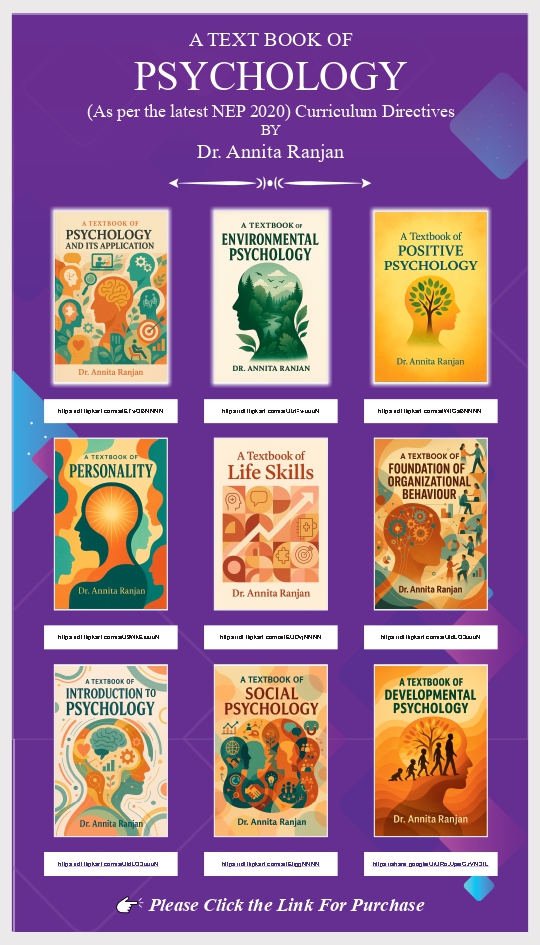
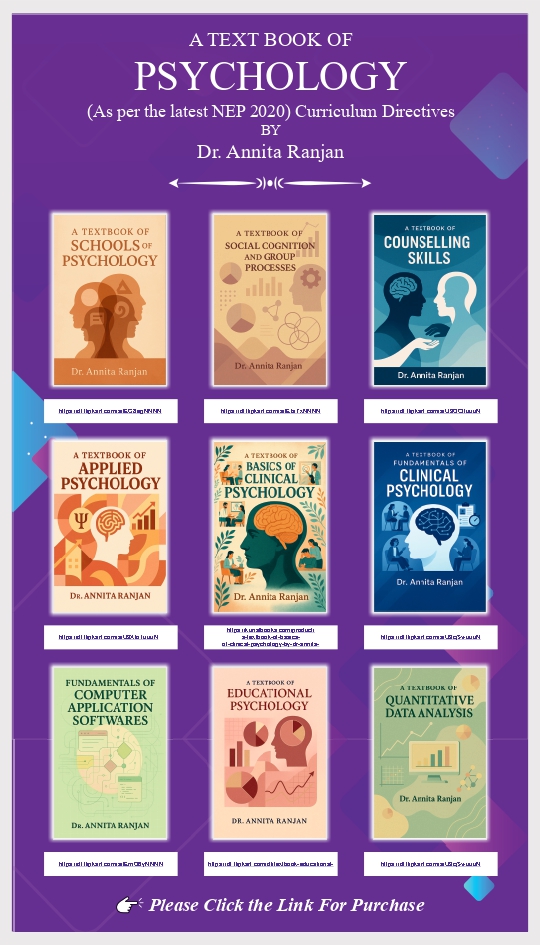
Serial No. | Name of Book | Purchase Link |
1 | A Textbook of Psychology and Its Application
| |
2 | A Textbook of Environmental Psychology
| |
3 | A Textbook of Positive Psychology
| |
4 | A Textbook of Personality
| |
5 | A Textbook of Life Skills
| |
6 | A Textbook of Foundation of Organizational Behaviour
| |
7 | A Textbook of Introduction to Psychology
| |
8 | A Textbook of Social Psychology
| |
9 | A Textbook of Developmental Psychology | |
10 | A Textbook of Schools of Psychology | |
11 | A Textbook of Social Cognition and Group Processes | |
12 | A Textbook of Counselling Skills | |
13 | A Textbook of Applied Psychology | |
14 | A Textbook of Basics of Clinical Psychology | |
15 | A Textbook of Fundamentals of Clinical Psychology | |
16 | Fundamentals of Computer & IT Softwares | |
17 | A Textbook of Educational Psychology | https://www.flipkart.com/textbook-educational-psychology/p/itmec1afcbbb6cc3 |
18 | A Textbook of Quantitative Data Analysis |