
UGC NET JRF Psychology Syllabus
1. Emergence of Psychology
Psychological thought in some major Eastern Systems:
- Bhagavad Gita
- Buddhism
- Sufism
- Integral Yoga
Academic psychology in India:
- Pre-independence era
- Post-independence era
- 1970s: The move to addressing social issues
- 1980s: Indigenization
- 1990s: Paradigmatic concerns, disciplinary identity crisis
- 2000s: Emergence of Indian psychology in academia
Issues:
- The colonial encounter
- Post colonialism and psychology
- Lack of distinct disciplinary identity
Western:
- Greek heritage
- Medieval period
- Modern period
- Structuralism
- Functionalism
- Psychoanalytical
- Gestalt
- Behaviorism
- Humanistic-Existential
- Transpersonal
- Cognitive revolution
- Multiculturalism
Four founding paths of academic psychology:
- Wundt
- Freud
- James
- Dilthey
Issues:
- Crisis in psychology due to strict adherence to experimental-analytical paradigm (logical empiricism)
- Indic influences on modern psychology
Essential aspects of knowledge paradigms:
- Ontology
- Epistemology
- Methodology
Paradigms of Western Psychology:
- Positivism
- Post-Positivism
- Critical perspective
- Social Constructionism
- Existential Phenomenology
- Co-operative Enquiry
Paradigmatic Controversies
Significant Indian paradigms on psychological knowledge:
- Yoga
- Bhagavad Gita
- Buddhism
- Sufism
- Integral Yoga
Science and spirituality (avidya and vidya)
The primacy of self-knowledge in Indian psychology
2. Research Methodology and Statistics
Research:
- Meaning
- Purpose
- Dimensions
Research problems, Variables and Operational Definitions, Hypothesis, Sampling
Ethics in conducting and reporting research
Paradigms of research:
- Quantitative
- Qualitative
- Mixed methods approach
Methods of research:
- Observation
- Survey [Interview, Questionnaires]
- Experimental
- Quasi-experimental
- Field studies
- Cross-Cultural Studies
- Phenomenology
- Grounded theory
- Focus groups
- Narratives
- Case studies
- Ethnography
Statistics in Psychology:
- Measures of Central Tendency and Dispersion
- Normal Probability Curve
- Parametric [t-test]
- Non-parametric tests [Sign Test, Wilcoxon Signed rank test, Mann-Whitney test, Kruskal-Wallis test, Friedman]
- Power analysis
- Effect size
Correlational Analysis:
- Correlation [Product Moment, Rank Order]
- Partial correlation
- Multiple correlation
Special Correlation Methods:
- Biserial
- Point biserial
- Tetrachoric
- Phi coefficient
Regression:
- Simple linear regression
- Multiple regression
Factor analysis:
- Assumptions
- Methods
- Rotation
- Interpretation
Experimental Designs:
- ANOVA [One-way, Factorial]
- Randomized Block Designs
- Repeated Measures Design
- Latin Square
- Cohort studies
- Time series
- MANOVA
- ANCOVA
- Single-subject designs
3. Psychological Testing
Types of tests
Test construction:
- Item writing
- Item analysis
Test standardization:
- Reliability
- Validity
- Norms
Areas of testing:
- Intelligence
- Creativity
- Neuropsychological tests
- Aptitude
- Personality assessment
- Interest inventories
Attitude scales:
- Semantic differential
- Staples
- Likert scale
Computer-based psychological testing
Applications of psychological testing in various settings:
- Clinical
- Organizational and business
- Education
- Counseling
- Military
- Career guidance
4. Biological Basis of Behavior
Sensory systems:
- General and specific sensations
- Receptors and processes
Neurons:
- Structure
- Functions
- Types
- Neural impulse
- Synaptic transmission
- Neurotransmitters
The Central and Peripheral Nervous Systems:
- Structure
- Functions
- Neuroplasticity
Methods of Physiological Psychology:
- Invasive methods
- Anatomical methods
- Degeneration techniques
- Lesion techniques
- Chemical methods
- Microelectrode studies
- Non-invasive methods
- EEG
- Scanning methods
Muscular and Glandular system:
- Types
- Functions
Biological basis of Motivation:
- Hunger
- Thirst
- Sleep
- Sex
Biological basis of emotion:
- The Limbic system
- Hormonal regulation of behavior
Genetics and behavior:
- Chromosomal anomalies
- Nature-Nurture controversy [Twin studies and adoption studies]
5. Attention, Perception, Learning, Memory and Forgetting
Attention:
- Forms of attention
- Models of attention
Perception:
Approaches to the Study of Perception:
- Gestalt
- Physiological approaches
Perceptual Organization:
- Gestalt
- Figure and Ground
- Law of Organization
Perceptual Constancy:
- Size
- Shape
- Color
- Illusions
Perception of Form, Depth and Movement
Role of motivation and learning in perception
Signal detection theory:
- Assumptions
- Applications
Subliminal perception and related factors
Information processing approach to perception
Culture and perception
Perceptual styles
Pattern recognition
Ecological perspective on perception
Learning Process:
Fundamental theories:
- Thorndike
- Guthrie
- Hull
Classical Conditioning:
- Procedure
- Phenomena
- Related issues
Instrumental learning:
- Phenomena
- Paradigms
- Theoretical issues
Reinforcement:
- Basic variables
- Schedules
Behaviour modification and its applications
Cognitive approaches in learning:
- Latent learning
- Observational learning
Verbal learning and Discrimination learning
Recent trends in learning:
- Neurophysiology of learning
Memory and Forgetting
Memory processes:
- Encoding
- Storage
- Retrieval
Stages of memory:
- Sensory memory
- Short-term memory (Working memory)
- Long-term Memory (Declarative – Episodic and Semantic; Procedural)
Theories of Forgetting:
- Interference
- Retrieval Failure
- Decay
- Motivated forgetting
6. Thinking, Intelligence and Creativity
Theoretical perspectives on thought processes:
- Associationism
- Gestalt
- Information processing
- Feature integration model
Concept formation:
- Rules
- Types
- Strategies
Role of concepts in thinking
Types of Reasoning
Language and thought
Problem solving:
- Type
- Strategies
- Obstacles
Decision-making:
- Types
- Models
Metacognition:
- Metacognitive knowledge
- Metacognitive regulation
Intelligence:
- Spearman
- Thurstone
- Jensen
- Cattell
- Gardner
- Stenberg
- Goleman
- Das, Kar & Parrila
Creativity:
- Torrance
- Getzels & Jackson
- Guilford
- Wallach & Kogan
Relationship between Intelligence and Creativity
7. Personality, Motivation, emotion, stress and coping
Determinants of personality:
- Biological
- Socio-cultural
Approaches to the study of personality:
- Psychoanalytical
- Neo-Freudian
- Social learning
- Trait and Type
- Cognitive
- Humanistic
- Existential
- Transpersonal psychology
Other theories:
- Rotter’s Locus of Control
- Seligman’s Explanatory styles
- Kohlberg’s theory of Moral development
Basic motivational concepts:
- Instincts
- Needs
- Drives
- Arousal
- Incentives
- Motivational Cycle
Approaches to the study of motivation:
- Psychoanalytical
- Ethological
- S-R Cognitive
- Humanistic
Exploratory behavior and curiosity
Zuckerman’s Sensation seeking
Achievement, Affiliation and Power
Motivational Competence
Self-regulation
Flow
Emotions:
- Physiological correlates
Theories of emotions:
- James-Lange
- Canon-Bard
- Schachter and Singer
- Lazarus
- Lindsley
Emotion regulation
Conflicts:
- Sources
- Types
Stress and Coping:
- Concept
- Models
- Type A, B, C, D behaviors
Stress management strategies:
- Biofeedback
- Music therapy
- Breathing exercises
- Progressive Muscular Relaxation
- Guided Imagery
- Mindfulness
- Meditation
- Yogasana
- Stress Inoculation Training
8. Social Psychology
Nature, scope and history of social psychology
Traditional theoretical perspectives:
- Field theory
- Cognitive Dissonance
- Sociobiology
- Psychodynamic Approaches
- Social Cognition
Social perception:
- Communication
- Attributions
Attitude and its change within cultural context
Prosocial behavior
Group and Social influence:
- Social Facilitation
- Social loafing
Social influence:
- Conformity
- Peer Pressure
- Persuasion
- Compliance
- Obedience
- Social Power
- Reactance
Aggression
Group dynamics
Leadership style and effectiveness
Theories of intergroup relations:
- Minimal Group Experiment and Social Identity Theory
- Relative Deprivation Theory
- Realistic Conflict Theory
- Balance Theories
- Equity Theory
- Social Exchange Theory
Applied social psychology:
- Health
- Environment
- Law
- Personal space
- Crowding
- Territoriality
9. Human Development and Interventions
Developmental processes:
- Nature
- Principles
- Factors in development
- Stages of Development
Successful aging
Theories of development:
- Psychoanalytical
- Behavioristic
- Cognitive
Various aspects of development:
- Sensory-motor
- Cognitive
- Language
- Emotional
- Social
- Moral
Psychopathology:
- Concept
- Mental Status Examination
- Classification
- Causes
Psychotherapies:
- Psychoanalysis
- Person-centered
- Gestalt
- Existential
- Acceptance Commitment Therapy
- Behavior therapy
- REBT
- CBT
- MBCT
- Play therapy
- Positive psychotherapy
- Transactional Analysis
- Dialectic behavior therapy
- Art therapy
- Performing Art Therapy
- Family therapy
Applications of theories of motivation and learning in School
Factors in educational achievement
Teacher effectiveness
Guidance in schools:
- Needs
- Organizational set up
- Techniques
Counselling:
- Process
- Skills
- Techniques
10. Emerging Areas
Issues of Gender, Poverty, Disability, and Migration:
- Cultural bias and discrimination
- Stigma
- Marginalization
- Social Suffering
- Child Abuse
- Domestic violence
Peace psychology:
- Violence
- Non-violence
- Conflict resolution at macro level
- Role of media in conflict resolution
Wellbeing and self-growth:
- Types of wellbeing [Hedonic and Eudemonic]
- Character strengths
- Resilience
- Post-Traumatic Growth
Health:
- Health promoting and health compromising behaviors
- Life style
- Chronic diseases [Diabetes, Hypertension, Coronary Heart Disease]
- Psychoneuroimmunology [Cancer, HIV/AIDS]
Psychology and technology interface:
- Digital learning
- Digital etiquette
- Cyber bullying
- Cyber pornography: Consumption, implications
- Parental mediation of Digital Usage
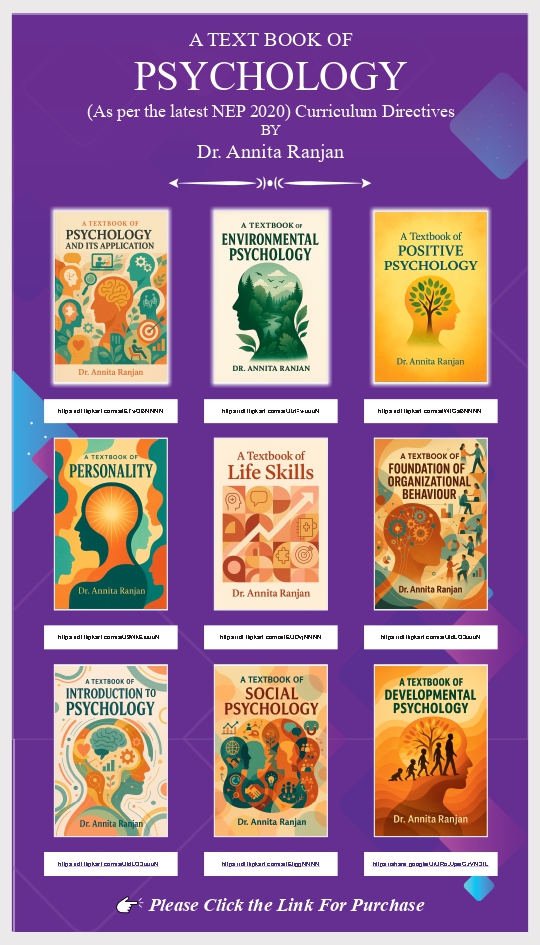
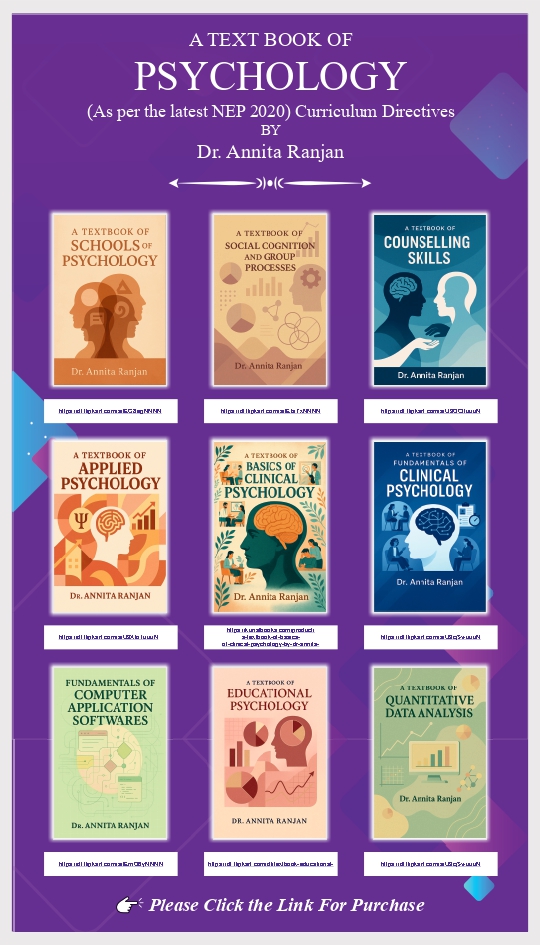
Serial No. | Name of Book | Purchase Link |
1 | A Textbook of Psychology and Its Application
| |
2 | A Textbook of Environmental Psychology
| |
3 | A Textbook of Positive Psychology
| |
4 | A Textbook of Personality
| |
5 | A Textbook of Life Skills
| |
6 | A Textbook of Foundation of Organizational Behaviour
| |
7 | A Textbook of Introduction to Psychology
| |
8 | A Textbook of Social Psychology
| |
9 | A Textbook of Developmental Psychology | |
10 | A Textbook of Schools of Psychology | |
11 | A Textbook of Social Cognition and Group Processes | |
12 | A Textbook of Counselling Skills | |
13 | A Textbook of Applied Psychology | |
14 | A Textbook of Basics of Clinical Psychology | |
15 | A Textbook of Fundamentals of Clinical Psychology | |
16 | Fundamentals of Computer & IT Softwares | |
17 | A Textbook of Educational Psychology | https://www.flipkart.com/textbook-educational-psychology/p/itmec1afcbbb6cc3 |
18 | A Textbook of Quantitative Data Analysis |